Pages

Showing posts with label biography. Show all posts

Sunday, October 29, 2017

SHARK LADY: THE TRUE STORY OF HOW EUGENIE CLARK BECAME THE OCEANS MOST FEARLESS SCIENTIST by Jess Keating, illustrations by Marta Álvarez Miguéns


So I'm a CYBILS nonfiction judge this year. And I should be blogging about all of the terrific books I'm reading every day. Time to get started.

SHARK LADY: THE TRUE STORY OF HOW EUGENIE CLARK BECAME THE OCEAN'S MOST FEARLESS SCIENTIST is the biography of oceanographer Eugenie Clark. The book follows Eugenie's life long love affair with sharks, starting at an aquarium when she was a little girl. In 1986, when she was 64, she made the first of over 12,000 trips in a submersible. In 2014, she celebrated her 92nd birthday by diving in Jordan and Israel. In between those years, she earned a doctorate in zoology, was a professor and author, discovered many new species of sharks, was the first to train sharks to prove their intelligence, and advocated for protection of our oceans. The book reads like a story, and that, along with Maria Álvarez Miguéns illustrations are lively and colorful and sure to hold kids' interest.

Lots to love about this book. Of course you could use it as a biography. But you could also use it to help kids understand that the passions they pursue in childhood really could lead to life long work. You could use it to show how important it is to persevere when people tell you your dreams aren't realistic. Or to show kids about all of the different ways of learning about a topic- Eugenie studied sharks in museums, read books and articles, took classes, and finally learned to dive. She kept track of her learning in research notebooks. 

And there were lots of great extras. The end pages are various kinds of sharks (I wondered if these were the species that Eugenie loved most or  discovered or ????). Back matter includes a page of "Shark Bites," (facts about sharks), an illustrated timeline, and author's notes.

Definitely a great addition to your picture book biography library.

Monday, November 17, 2014

ALICE WATERS AND THE TRIP TO DELICIOUS- JACQUELINE BRIGGS MARTIN


Our second graders do a unit on advocacy each year. I'm always on the lookout, then, for books about people who are advocates, especially in a way that children will understand. ALICE WATERS AND THE TRIP TO DELICIOUS, by Jacqueline Briggs Martin, author of SNOWFLAKE BENTLEY and more recently FARMER WILL ALLEN AND THE GROWING TABLE, definitely fits into that category.

Alice Waters spent part of her young adulthood in Europe, tasting yummy foods, then opened a restaurant, Chez Panisse. At the time most chefs were men. And most restaurants worried about finding good recipes, not good ingredients. Alice Waters changed all of that. She cooked with only the freshest ingredients and her restaurant became hugely popular.   Alice was the first woman to win the James Beard Chef of the year. She cooked for presidents and for the Dalai Lama.

But that wasn't enough for Alice. Every day as she packed her daughter's lunch, and as she drove by schools, she wondered whether children were having opportunities to taste fresh and delicious food. When the principal of a middle school contacted her, she paired with that school and the The Edible Schoolyard Project was born. Now there are Edible Schoolyards across the United States, because

Alice Waters is sure:
Kids who know good food,
who grow, gather, and share good food,
will care about the soil, care about farmers,
care about everyone having enough to eat.

Kids who get to Delicious can change the world. 

This is illustrator Haelin Choi's first picture book, and her playful illustrations capture the essence of the book. Back matter includes an afterword by Alice Waters (advice for kids about growing and eating food), an author's note, a list of resources for further research, and a bibliography.

Saturday, November 15, 2014

STAR STUFF- STEPHANIE ROTH SISSON

Carl Sagan seems a pretty complex guy for a picture book, but Stephanie Roth Sisson manages to make his life accessible to kids in her biography, STAR STUFF: CARL SAGAN AND THE MYSTERIES OF THE COSMOS. Sisson traces Sagan's life from his boyhood, growing up in the Bronx and attending the 1939 World's Fair, (I especially loved a page where Sagan goes to the library to get a book about stars and is first given a book of Hollywood stars) to his adulthood fascination with planets and stars, including his work on the Voyager. Throughout the book, Sisson manages to convey Sagan's continual curiosity and wondering. Several vertical and foldout pages emphasize the immensity of the universe and add to the visual appeal. End pages include a note from the author, information on sources, and a bibliography.

Monday, November 11, 2013

THREE BOOKS ABOUT BASEBALL


I know it's not baseball season, but  I have three baseball books at the top of my CYBILS stack today, so baseball it is. The first, BARBED WIRE BASEBALL, is about the Japanese Interment Camps during World War Two, so it kind of fits with Veteran's Day, right?

Kenichi "Zeni" Zenimura grew up in Hawaii. Although his parents wanted him to be a doctor or a lawyer, Zeni knew, from a very early age, that he wanted to play baseball. Zeni grew up, moved to California, and played baseball in the Fresno Nisei and Fresno Twilight Leagues. He even played in exhibition games against greats like Babe Ruth and Lou Gehrig.

In 1941, after the Japanese bombed Pearl Harbor, Zeni and his family were sent to an interment camp in Gila Bend, Arizona. Circumstances were bleak and it would have been easy to give up. Zeni refused to let his circumstances define him, however, instead choosing to build a baseball field and organizing 32 teams into three divisions, which played every day. 

This book would be terrific in a unit on World War Two, Japanese Americans, or perseverance. It would also be a perfect companion for one of my favorite historical picture books, BASEBALL SAVED US.  End notes include biographical information about Zeni, as well as author and illustrator's notes. 


Another book that could easily be used in a Social Studies class is Jonah Winters' and Terry Widener's YOU NEVER HEARD OF WILLIE MAYS. Mays, as most people know, was one of the first African Americans to play with the New York Giants. Winters' biography captures Mays' childhood in Birmingham, his years in the Negro League, and then his ascent to the majors, where he was Rookie of the Year, and is famous for a play known as "The Catch" in 1954. Embedded ticket-shaped insets throughout the book feature important baseball-related information. The holographic cover will grab kids' attention, but it doesn't begin to compare with Widener's gorgeous illustrations throughout the book. Endnotes include a glossary, and information about where the authors got their statistics.


BECOMING BABE RUTH is a biography by one of my favorite picture book authors and illustrators, Matt Tavares. The story begins in 1902, when George Herman Ruth's father, disgusted with his naughty and delinquent seven-year-old son, sends him to Saint Mary's Industrial School for Boys, There, Babe Ruth meets Father Matthias, a baseball playing priest, who guides and mentors young Ruth, and shapes him into a world class baseball player. This biography captures important details about Ruth's baseball career, but also includes lots of information about his lifelong relationship with Father Matthias and the Saint Mary's industrial school. Author's notes include pitching and hitting statistics.


Thursday, November 11, 2010

SKIT-SCAT RAGGEDY CAT: ELLA FITZGERALD by Roxanne Orgill


Ella Fitzgerald did not have an easy childhood.
She lived with her mother, Tempie, and stepfather, Joe, until she was fourteen, then Tempie died suddenly, and Ella was sent to live with her Aunt Virgina, who "offered meals and a roof, and nothing more."

Ella started skipping school and getting into trouble, and was sent upstate to a reform school where they "it was a regular routine to leave a girl in the basement, in chains, with nothing but bread and water." After two years, she ran away from the school, and ended up back in Harlem, where "people took her in and gave her a meal and a bed, or didn't…At the Baptist church, Ella got a pair of men's boots to keep the cold off her dancing feet."

But Ella persevered. She won a spot at Amateur Night at the Apollo Theater. Heer voice cracked during her first few notes, and a kind emcee stepped to the microphone and said, "This young lady's got a gift she'd like to share with us tonight. She's just having a little trouble getting it out of the wrapper. Let's give her a second chance." Ella won first prize at that contest, but did not win the usual week with the band because of her raggedy appearance. Later, Ella won another amateur night at the Harlem Opera House. Soon, she found herself being introduced to Chick Webb. One of Webb's trombone players gave her a bar of soap, and told her to wash herself good. The costume mistress took a comb to her tangled hair every night. Soon, Webb and Fitzgerald's song, "A-Tisket, A-Tasket," was a number one hit on the radio. And after that, it was "so long, Skit-Skat Raggedy Cat. It's Rowdy-Dowdy High Hat Baby now."

This picture book biography, with its colorful, predominantly red and blue illustrations by Sean Qualls, has much to say about persevering and overcoming odds. The text is a little long, so it's probably a better read for intermediate grades, or middle or high school. And it would probably be even more meaningful if kids could see this link to Ella Fitzgerald singing A-Tisket, A-Tasket, or check out Fitzgerald's official website here.

Monday, May 17, 2010

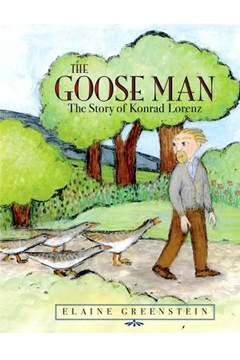
THE GOOSEMAN: THE STORY OF KONRAD LORENZ by Elaine Greenstein

At one of my first teaching jobs, I was privileged to work with a facility manager named Mel, a sweet, sweet, sweet, retired army veteran with a heart of gold. Mel loved his building, loved his teachers, and loved the kids. The second or third year we worked together, our class hatched turkey eggs. Mel and the babies took a liking to each other. Every morning when he arrived at work, he would take the turkeys out of their pen and they would follow him up and down the halls. When Mel started the vacuum, the baby turkeys would scurry back out into the hall and peep worriedly until Mel emerged.

I couldn't help but think of Mel as I read THE GOOSEMAN: THE STORY OF KONRAD LORENZ. Lorenz is the scientist best known for the development of a ethology, the study of animal's instinctive behaviors. Us common folk probably know him better as the person who studied the imprinting behaviors of ducks and geese. From a very young age, Konrad loved, loved, loved animals. His parents encouraged his passion, even allowing him to have a monkey that snatched shiny things away from anyone who came to visit. As an adult, Lorenz studied medicine, but soon left the field to pursue his interest in animals. He spent his entire life studying the behaviors of ducks, geese, and other wild animals. Early in his career, he had a goose named Martina who actually slept with him, and brought her "boyfriend" home to meet him.

This will be a fun book to share with our first graders, who are eagerly watching an incubator full of duck eggs…

Monday, January 11, 2010

The Long Snapper- Jeffrey Marx

Things my sons like: sports, girls, video games. Things my sons do not like: school, deep conversations with their mother, reading. As a mom and a reader, this breaks my heart, and I'm on a never-ending quest for "the book" that will turn them into readers. Add this title to that list.

Brian Kinchen is teaching his fourth period class at Parkview Baptist Middle School when he gets a call from the New England Patriots. They are two weeks from the playoffs and their long snapper is hurt. They want Kinchen, a retired 13 year veteran of the NFL, to try out for the position. Kinchen wins the position, and ultimately ends up as the snapper for the Patriots game-winning Super Bowl field goal.

In the six weeks in between the tryout and the Super Bowl, however, Kinchen goes through a horrific slump. During his 13 years in the NFL, he was known as a perfectly accurate and dependable snapper, but now, all of a sudden, his snaps are going everywhere but where they need to be. Kinchen does everything he can- watches himself on film, consults coaches, other players, practices every night at his motel, prays. He is terrified that his inconsistency will lose the big game for his team, and at one point, three days before the Super Bowl, even goes so far as to call the coach who brought him in for the tryout to tell him that he needs to find another long snapper.

This is a great story about passion and purpose and self esteem. My favorite lines from the book actually come from the movie Cool Running, about the Jamaican Bobsledding team. In the movie, it is the night before a big race, and the coach is talking to his team's driver. "A gold medal is a wonderful thing," he says. "But if you're not enough without it, you'll never be enough with it."

It's funny how sometimes books you read for other people end up speaking loudly to you…

Saturday, November 7, 2009

JOHN BROWN: HIS FIGHT FOR FREEDOM- JOHN HENDRIX

Some people don't believe that children should be exposed to controversial figures. If you are one of those people, then JOHN BROWN is probably not a book for you. If you believe, however, that children need to understand that most people are neither entirely good nor entirely bad, that sometimes very good people make poor decisions, and that kids learn from talking about controversy, then JOHN BROWN is a book you will enjoy sharing with your upper elementary, or middle or high school students.

John Brown was an ardent Christian. He believed that blacks should not only be free, but that they should be EQUAL- toward that end, he was kicked out of his home church for giving African Americans his pew at the front of the church after they had been seated in the back. Brown began his abolitionist roots working on the underground railroad in Hudson, Ohio. After the United States passed the Kansas-Nebraska act, which said that those two states could vote on whether they would enter the Union as free or slave states, Brown fought tirelessly to ensure that Kansas would be free. In one well-known battle, John and his sons stormed the homes of five pro-slavery settlers who had been threatening his family and other abolitionists, took the men to a creek, and killed them.

John Brown is perhaps best known for his role at Harper's Ferry. Harper's Ferry, the home of a federal armory which housed more than one hundred thousand rifles, was viewed as a symbol of Southern power. Brown decided that he and a small band of abolitionsists would capture the armory and seize the rifles, then use them to battle the Southern slave owners. Although he was initially successful, he made several poor decisions during this battle, and was eventually captured and hanged as a traitor. Many dismiss Brown as a madman. Hendrix, however, believes that we must see Brown as a man with huge passion and convictions for the downtrodden.
"I will raise a stom in this country that will not be stayed so long as there is a slave on its soil."
I love when illustrations help kids understand a complex story, and John Hendrix's frontier style water colors (I'm not sure that is exactly how to describe them, but it's the best this non-artist can do) done on backgrounds of blues, tans, and golds, definitely do that. Most are bold, two-page spreads, that include a larger than life John Brown, but a few are also maps. Key quotes figure prominently in many of the illustrations. And if you enjoy reading author's blogs, John Hendrix has a great one- he includes photographs from a recent John Brown book tour, but also pages from his sketchbook.

I'll be sharing this book not only with our fourth and fifth graders, but also with some of my high school history teacher friends!

Friday, November 6, 2009

POETRY FRIDAY- WHEN POETRY MEETS HISTORY


CORETTA SCOTT
Poetry by Ntozake Shange
Paintings by Kadir Nelson

For POETRY FRIDAY today, I'm not sharing just a poem. Instead, I'm sharing a biography in a poem. Actually a civil rights biography in a poem. Today I'm sharing Ntozake Shange's beautiful poetry picture book, CORETTA SCOTT. Shange has taken just a few events from Coretta Scott's life, and shaped them into a beautiful poem. Listen to this page, when Coretta and her younger siblings are walking to school…

white school bus
left a
funnel of dust
on their faces
but

songs and birds of all colors
and rich soil
where slaves sought freedom
steadied them
in the face of danger
The illustrations in this book are by Kadir Nelson (WE ARE THE SHIP, HENRY'S FREEDOM BOX, HE'S GOT THE WHOLE WORLD IN HIS HANDS) who is most definitely one of my all-time favorites. The illustrations in CORETTA SCOTT are his usual- rich details, vivid colors, so real the people almost seem to jump off the page.

If I was doing a unit on biography, or teaching students about Coretta Scott King, I would probably read a more traditional biography first (there is actually a brief biography in the back of this book), then share Shange's poem. Prior to reading CORETTA SCOTT, I'd ask kids to list important events from her life, then to listen for these as I read. The book is short, so I could read it two or three times to let kids soak in the beautiful language. If kids were writing biography, I might ask them to choose a few important events from the person's life, then write a poem, using CORETTA as a mentor text.

This is definitely a book to add to your poetry and/or biography collection…

Saturday, April 4, 2009

THE ANNE FRANK CASE: THE STORY OF SAM WIESENTHAL

I have always thought that I would love to teach high school history. If I did, picture books and historical fiction would be an important part of the curriculum. This year, I've read lots of books I'd have to include in my curriculum. I'd have to read Laurie Halse Anderson's amazing new novel, CHAINS, when we studied the Revolutionary War. I'd use LINCOLN THROUGH THE LENS when we studied the Civil War. For the Civil Rights movement, I'd bring in NEW BOY and WE ARE THE SHIP. This weekend, I read a picture book I'd have to use when we talked about the Holocaust.

THE ANNE FRANK CASE: THE STORY OF SAM WIESENTHAL is the story of a Jewish Holocaust survivor. At the opening of the book, a group of Austrian neo-nazi teenagers disrupt a theater performance of Anne Frank’s Diary of a Young Girl, claiming that the Holocaust never occurred. Wiesenthal decides he must find the Gestapo officer who arrested Anne Frank. The book then flashes back to trace Wiesenthal's experiences during the war, which included time in the Concentration camps, loss of multiple family members, separation from his wife, and two very near-death experiences. His own experiences make him a patient but tenacious detective in solving this mystery.

This book would be great in a text set with ANNE FRANK (of course), NUMBER THE STARS, THE BOY IN THE STRIPED PAJAMAS, and for struggling readers, SNOW TREASURE.

Monday, February 16, 2009

THE LAST BLACK KING OF THE KENTUCKY DERBY

Author: Crystal Hubbard
Illustrator: Robert McGuire
Publisher: Lee and Low
Review copy provided by publisher


This weekend my son's basketball team lost a really tough game.   The boys are eighth graders, many of them have been together since first grade, and we're in kind of a bittersweet time, because next year they'll be splitting up and heading off to different high schools. 

This loss was an especially tough one for several reasons. First, they won this league last year and really wanted to do it again. Second, the team that won is a team they beat 90% of the time. Third and hardest, the team wasn't lost by the kids, it was lost by a referee, when he allowed the other team to take one too many free throws. They won by one point. That extra free throw put them ahead, when really the game should have been tied at regulation and gone into overtime. 

Talking about it later, all my son could say was that it wasn't fair, that they had not really lost the game. And I had to agree with him, they hadn't. All I could say was that sometimes life was not fair and sometimes people in authority behave in dishonorable ways. Sometimes we can't do anything about injustices that are done to us. All we can do is take charge of our attitudes and our behaviors. And sometimes it is  really hard.

Then I thought of Crystal Hubbard's wonderful new picture book, THE LAST BLACK KING OF THE KENTUCKY DERBY. The LAST BLACK KING is the story of Jimmy Winkfield, an African American jockey and horse trainer. Winkfield rode in the Kentucky Derby in 1900, 1901, 1902, 1903,  finishing third in 1900, winning the race in both 1901 and 1902, and coming in second in 1903. Given his tremendous success, one might have expected that he would have gone on to ride in the Kentucky Derby many more times. Surprisingly, Winkfield never rode in the Derby again. In fact, since 1902, however, no African American jockey has ever won the race. Winkfield truly was the "last black king of the Kentucky Derby."

Why, after such finishing in the top three for four years running, did Winkfield not compete again? The answer is simple. He was black. Racism was prevalent. The Kentucky Derby was a big purse for jockeys. Other jockeys were given preferential treatment because they were white. Jimmy Winkfield finished his career as jockey in Russia, where he won many races, married a Russian heiress, then had to drive a herd of thoroughbreds out of the country during the Russian Revolution in 1917. He emigrated to France, where he had to defend himself with a pitchfork during World War I. Life truly wasn't fair. And yet Winkfield made choices, again, and again, and again, which allowed him to survive and thrive in spite of other people's wrong actions.

Robert McGuire's colorful, beautifully detailed illustrations greatly enhance this story. My favorite is a picture of all of the horses running, where McGuire went so far as to use a sponge or splatter painting to show the dirt/mud coming off the horse's hooves. Amazing illustrations!

I shared this book with my fourth and fifth graders on Friday, and with my son this weekend. This week we will read Kadir Nelson's WE ARE THE SHIP. The kids I teach and love need to know how to respond when life treats them unfairly. They need to know that people can rise above very difficult circumstances…

Sunday, February 8, 2009

SEVEN MILES TO FREEDOM: THE ROBERT SMALLS STORY

AUTHOR: Janet Halfmann
ILLUSTRATOR: Duane Smith
Review copy provided by Lee and Low

Have you heard of Robert Smalls? I hadn't, at least not until I read this beautiful new biography. Now,  I can't wait to introduce to my students and my sons to Robert Smalls.

Smalls was born in the slave quarters of the McKee family plantation in Beaufort, South Carolina, in 1839. His mother was a house servant, and Robert soon began working in the house as well. He was smart and talkative, and quickly became Master McKee's favorite servant. As such, Robert had an easier life than most slaves. Even so, he witnessed the evils of slavery- cruel beatings, children sold on the whipping block, and families torn apart. He grew to despise slavery.

When Robert was 12, he was sent to Charleston to work in a hotel. He was fascinated by boats, and soon convinced Master McKee to allow him to work in the shipyards, where he sewed and rigged sails, and became known as one of the best boat handlers on the water. During this time, he also married Hannah Jones. When they had their first daughter, Elizabeth, Robert was saddened to realize that the child actually belonged to Hannah's owner. He determined that somehow he would earn $800 to buy his wife and child, so that the family would never have to worry about being torn apart. 

By the spring of 1861, the southern states had seceded from the Union, and the Civil War had begun. There was very little commercial boat traffic in or out of Charleston, so Robert took a job on the Planter, a 147-foot wood burning steamer. On May 12, 1862, Robert and other members of the crew boldly stole the ship, loaded with four Confederate cannons, used a rowboat to pick up their families, and sailed out of the harbor and past several Confederate forts, finally surrendering the boat and the four cannons to the Union navy. In an afterword, we learn that Smalls was later declared a national hero, and convinced Abraham Lincoln to allow African Americans to enlist in the Union army. He helped draft the constitution for the state of South Carolina, and served as a member of the United States congress. Unfortunately, he was also one of six African American delegates who refused  to sign an amendment to the state constitution when South Carolina repealed African American's right to vote in 1895.

This is a terrific story of an amazing Civil War hero. The illustrations, done by Duane Smith, are stunning, oil paintings in all hues of blue, turquoise, green, orange, and gold. The paintings are really different, lots of really broad brush strokes, with the details being done in different shades of the same color. It's hard to describe, but I could see art teachers using Smith's work to teach students about oil painting. This is Smith's first picture book, and he goes right under Kadir Nelson on my list of favorite illustrators.

A great book for African American history month, or a unit on the Civil War, or heroes, or bravery, or biographies…

Sunday, January 4, 2009

LINCOLN THROUGH THE LENS: HOW PHOTOGRAPHY REVEALED AND SHAPED AN EXTRAORDINARY LIFE- Martin W. Sandler

As many of you know, this year I was a CYBILS panelist for Intermediate Grade/YA Nonfiction. Since the middle of October, I've read almost sixty terrific nonfiction books- everything from biography and memoir, to science experiments, to real-life historical mysteries, to girls' health books. Our panel had to have all of the books read and select our top 5-7 by the end of the year. The shortlists were announced on January 1st. I got the books read, but still have 10-15 that I have not reviewed. I'll be finishing those up over the next few weeks. 

LINCOLN THROUGH THE LENS: HOW PHOTOGRAPHY REVEALED AND SHAPED AN EXTRAORDINARY LIFE is one of the books that made it onto our shortlist. The book chronicles how Abraham Lincoln, one of America's most beloved presidents, used photography, the newest technology of his era, to propel himself into the White House, free the slaves, and ultimately, save our country. As I read it, I couldn't help but think of how Obama used the internet, text messaging, etc. during his 2008 campaign.  Or of Franki and Mary Lee's conversations about 21st century literacies

Historian Martin Sandler has done a masterful job telling the story of Abe Lincoln's life through stories, quotes, photographs, and drawings. Each two-page spread addresses a certain period or event in Lincoln's life. The left page contains a quote from Lincoln and a few paragraphs of text, and usually a photograph or drawing. The right-facing page contains one large image, usually a photograph. Commenting about the book, one of the CYBILS panelists said, "It's not often that we find a book where the author does such a masterful job melding story and images." I totally agree with her. 

LINCOLN THROUGH THE LENS would be a terrific read aloud for Lincoln's 200th birthday in February. The text and information  are appropriate for kids from second or third grade all the way through adult. Because of the way the sections are divided, it would also be an outstanding read aloud for middle and high schoolers (and yes, I absolutely do believe we should be reading aloud to older kids!)

Happy Birthday Abe! And thank you, Martin  Sandler!

Tuesday, December 16, 2008

AMELIA EARHART: THE LEGEND OF THE LOST AVIATOR by Shelley Tanaka

This week, my CYBILS reading has taken me from swords to pilots. While SWORDS and AMELIA EARHART: THE LEGEND OF THE LOST AVIATOR might not, at first, seem very similar, both books have a common thread. They're both really engaging because they are both about people brave enough to throw themselves wholeheartedly into their passions. In my mind, that always makes for interesting reading.

Amelia Earhart saw her first airplane in 1908 at the Iowa State Fair.  THE LOST LEGEND traces Earhart's life from childhood until she and her airplane vanished on a round-the-world flight in 1937. An epilogue explores possible outcomes of the Earhart mystery. Several themes, e.g. girls can do anything, follow your dreams, and don't be afraid to take risks, resonate throughout the book.

AMELIA EARHART is a really readable biography- simple enough for an average fourth or fifth grader, but also interesting enough to hold a middle schooler's attention. The body of the text is supplemented with occasional sidebar information on related topics, e.g. the history of flying, other women pilots, Earhart's fan mail. Visuals in AMELIA EARHART are also worth noting. The book contains a number of captioned photographs from Earhart's life. It includes an equal number of beautiful paintings by David Craig. 

A great book for a biography unit, or a unit on women pioneers (or actually any pioneers), or a kid who is interested in flying, or just because…

Saturday, October 18, 2008

SHE TOUCHED THE WORLD: LAURA BRIDGEMAN, DEAF-BLIND PIONEER

When I was nine or ten, I read FOLLOW MY LEADER, a novel about  a boy who lost his sight after an accident with fireworks. Much of the book, or the parts I remember anyway, occur at a training academy for guide dogs, as Jimmy is learning how to work with his new companion. I was fascinated by this book and went on to read several other books about guide dogs and blindness. Inevitably, I eventually encountered books about Helen Keller.

Many books about Helen Keller mention Laura Bridgeman, who was actually born about fifty years earlier. Bridgeman lost her vision and hearing at the age of three, after a bout with scarlet fever. She spent most of her life at the Perkins School for the Blind, under the tutelage of Dr. Samuel Howe. Bridgeman was an extremely intelligent young woman, who basically learned how language works  in one afternoon. Dr. Howe used his research with Laura as a basis for teaching many deaf-blind people, including Helen Keller. SHE TOUCHED THE WORLD is the story of Bridgeman's life.

Throughout the book, I'm struck again and again by the loneliness Bridgeman must have endured throughout her life. She lived with her family until she was nine or ten, and spent a great deal of her time with Asa Tenney, a farmhand who cared for her, took her on walks around the farm, and actually bought a plate with raised alphabet letters around the rim, in hopes that Laura could somehow be taught to communicate. Later, she lived with Howe and his sister, then had a series of teacher/companions who spent many, many hours with her each day. Most of these people, however, were a part of Bridgeman's life, then moved on to marry or pursue other dreams. I suspect that some kids, especially those of the more solitary nature, might also notice this theme. 

SHE TOUCHED THE WORLD is a short, highly readable biography, crammed full of stories and information. Photographs from provide valuable information about the time period. I also loved the afterword, "If Laura Were Alive Today," because it tells how technology has expanded worlds of deaf and blind people. Author Sally Hobart Alexander, who paired with her husband to write this book, is blind and partially deaf, so I suspect much of this information is drawn from firsthand experience. 

I'd pair this book with MISS SPITFIRE, a terrific  biography of Annie Sullivan that was published last year. I think kids will love it!

Thursday, October 16, 2008

LINCOLN SHOT: A PRESIDENT'S LIFE REMEMBERED Barry Denenberg

LINCOLN SHOT: A PRESIDENT REMEMBERED is a biography by historian Barry Denenberg. The book, designed to appear like a memorial edition of the National News, a fictitious newspaper from the 1860's, opens on the day Lincoln is assassinated. 

I've always loved history. I love it because history, presented well, truly is the STORIES of people's lives. Denenberg skillfully weaves stories of Lincoln's life with quotes and photographs. I loved learning about Mary Todd Lincoln- did you know she came from a wealthy family who vehemently opposed their daughter marrying beneath her social station, to the point that Mary and Abe even broke off their courtship for an extended period of time? Did you know she hated Washington D.C., and when they first moved there, she stayed only a few months before returning home with her children? Did you know that she spent so much to remodel the White House, that she was forever scorned by the government officials and the press?

It's the stories from the Civil War, however, that are the centerpiece of this very powerful book. Denenberg tells those stories with amazing detail-- stories of the events leading up to the war, stories about the lives of bumbling and contentious generals, stories of  battles where fathers watched their children die, stories of the horrendous decisions Abraham Lincoln faced every day and the toll they took on his mental health. The stories are so detailed and so well-told that I could see using this as a textbook or read aloud for a high school history class. Denenberg uses many, many quotes from Abraham Lincoln, and also pieces of actual correspondence, to further enhance the stories. 

I have a few questions about using this book. The pages in the book, as I said earlier, are designed to look like a newspaper from the 1860's. Everything-- the fonts, the pictures, the advertisements, even the SIZE of the pages carry through on that theme. And it's the size that concerns me a little. This book is HUGE, and I mean HUGE, easily double the size of a regular book. Because of the size, it's not a book that will be easy to read aloud,  It's not a book that will fit in kids' desks at school. It's not a book you could carry in your purse or even your backpack. It's not even a book that's fun to read in bed, you really need a table to prop it on.

But when you figure out how to hold it, the information is so, so wonderful…

Tuesday, July 15, 2008

BIG RUSS AND ME

I have to confess. I'm not much of a television watcher, and I'm sure not a Sunday morning television watcher. When my mom told me that Tim Russert had passed away, I had to think for a minute to remember who Tim Russert was.

Nevertheless, I'm fascinated by the stories of people's lives- who they are, what experiences shaped them, who they love, etc. Last weekend, then, I picked up BIG RUSS AND ME, the story of Tim Russert's relationship with his father. Russert grew up in a working class neighborhood in South Buffalo. His father, Big Russ, always held two jobs. First, he was a garbage collector and later a supervisor in the Sanitation Department. Then he drove a truck that delivered the newspaper in Buffalo. Tim grew up attending parochial schools. He talks again and again about the teachers, the nuns and priests that mentored and shaped him into the scholar, the thinker, and the man he became. 

In some ways, Russert's upbringing reminds me of my own. Big Russ believed in hard work, and discipline. Tim knew that the teachers/coaches/bosses were always right, and if he got in trouble at school, he would be in twice as much trouble at home. Big Russ, however, was also man who loved his wife and his kids, and who laughed often. Hearing people talk about Tim Russert in the past few weeks, it would appear that he inherited all of these qualities from his dad.

Most of all, Big Russ was a man of huge integrity. When I talk about integrity with my boys (and we talk about this subject on an almost daily basis) , I always tell them that everyone in your life- your family, your coaches, your teachers, your friends, the salesclerk at the grocery store- would describe you in the same way, and that you make the right choices and do the right thing whether or not anyone is watching you. My dad, as imperfect and human as he was, was a man of huge integrity. I hope I inherited this quality, and I hope I pass it to my guys. 

This book has made me laugh and cry. Big Russ reminds me of my dad- how hard he worked, how little he said,  and how much he loved us. He's been gone almost fifteen years.…