Pages

Saturday, November 6, 2010

TWO MORE CYBILS TITLES BY STEVE JENKINS


As I said yesterday, Steve Jenkins and Robin Page write some of my favorite kids' nonfiction. Their books are engaging, factually accurate, and full, full, full of fascinating illustrations. It doesn't surprise me then, that Jenkins and/or Jenkins and Page are the author/illustrators of three books on the CYBILS nonfiction picture book list.

Yesterday, I reviewed HOW DO YOU CLEAN A HIPPOPOTAMUS? Today, it's NEVER SMILE AT A MONKEY a book I would describe as "typical" Steve Jenkins, (if there is such a thing). Each page or two-page spread features one of Jenkins' beautiful cut/torn paper collage illustrations. Somewhere on the page, there's also an admonition, done in a large font. Accompanying that is a paragraph of more detailed explanation. You never smile at a monkey, for example, because they might take the show of teeth as a display of aggression and respond in similar fashion. You should also never bother a blue ringed octopus, collect a cone shell, pet a platypus, or harass a hippopotamus. Using seventeen different examples, Jenkins explains how different animals have adapted for survival in their environment.

Jenkins' newest title, BONES, about "skeletons and how they work" is also nominated for this year's CYBILS. I gotta tell you, I. LOVE. THIS. BOOK. Each two page spread compares a different aspect of the human skeletal system to that of several animals. I loved, loved, loved the foldout spread of the python's ribcage (Jenkins' meticulous attention to detail and accuracy is so evident in this illustration-- this particular python was a six footer with 200 hundred pairs of ribs, but larger pythons can have up to 400 pairs). I also loved the skull page- this foldout featured actual-sized skulls of eleven different species, including a human, a green turtle, a butterfly fish, and a tree shrew. Four pages of appendices are newspaperish articles about bone related topics.

The illustrations in this book are over the top terrific. The background of each page is solid colored, with bones that are mottled whites, grays, and tans. Each page tells how the skeleton compares to actual sized bones. And there's even a bit of humor- check out the page where a rhino skeleton chases a human, or the last page, where a human skeleton is waving goodbye.

This book is my nominee for the Caldecott!

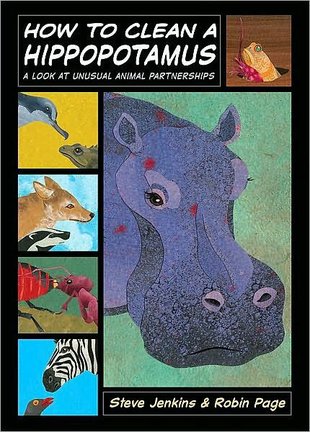
HOW TO CLEAN A HIPPOPOTAMUS- Steve Jenkins and Robin Page


When I see the names Steve Jenkins or Robin Page attached to a children's book, I know several things:

1) The book will be jammed full of interesting information, the kind of knockout nonfiction that children revisit again and again.
2) The research will be solid and thoughtful. There will be appendices with additional information.
3) The artwork will be gorgeous torn/cut paper collage. There is often a clever twist in the book design, e.g. the depth meter along the right hand side of each page in DOWN, DOWN, DOWN (one of last year's CYBILS awards finalists).
4) I will find myself asking, "How did they get interested in this topic? And where in the world did they find all this bizarre information?
"


And yep, all of those things are definitely true with HOW TO CLEAN A HIPPOPOTAMUS one of the the newest books by Colorado author/illustrator husband/wife team, Steve Jenkins and Robin Page. HIPPOPOTAMUS explores the symbiotic partnerships between animal species all over the Earth:
  • Zebras, wildebeests, and ostriches often graze together on the African plains. Zebras have excellent hearing, wildebeests have an acute sense of smell, and ostriches have great eyesight. They work together to help defend themselves against predators.
  • Coyotes and badgers hunt prairie dogs together. The coyote leads the badger to a prairie dog burrow. The badger digs at the front door, and the panicked prairie dogs attempt to flee out the back, where the hungry coyote is waiting. They return to the front, where they are confronted again by Mr. Badger.
  • The clownfish hides from its enemies among the stinging tentacles of a sea anemone. The toxin of the anemone, however, is very poisonous, and the clownfish must build up its immunity to this toxin by gradually brushing against the tentacles. If the clownfish leaves its safe haven for more than 45 minutes, it has to start all over again. And it is not immune to the toxin of all sea anemones, only one.
The artwork in HOW TO CLEAN A HIPPOPOTAMUS is, as expected in a Jenkins and Page offering, is gorgeous cut/torn paper collage. But instead of one or two animals per spread, each page in this book consists of a series of panels, almost like those found in comic books. And the layout is different on each page. I spent at least five minutes exploring each two-page spread, then went back to look at some again. I know the illustrations will hold this same fascination for kids. I'm thinking right now about whether I might have kids use the book as a mentor text for "visual reports" when they do research.

Steve Jenkins has a terrific website. I especially loved the section about how he researches and creates his books. Check that out here.

Another winner by Jenkins and Page!

Thursday, November 4, 2010

POETRY FRIDAY

IN HONOR OF MY BOYS ENTERING THE PLAYOFFS

RUN THE RACE
Raymond A. Foss
If only we would just run forward,
mile on mile, not look backward,
behind us, second guessing, looking for the pack
the enemy, the assurance of the approval
of society, peers, neighbors, friends
If we could only look to the Savior,
follow the Spirit, live the scriptures
We must run the race that has been set before us
and focus on our reward at the finish line

Finished July 23, 2007 16:51
Started March 4, 2007
Philippians 3:12-4:1
Sermon “A Race Everyone Can Win”
by Rev. Peter Hey, 3/4/07
using football and the Boston Marathon as symbols
of the work we must do, the way we should live

Wednesday, November 3, 2010

THE SHOCKING TRUTH ABOUT ENERGY- Loreen Leedy

As an elementary teacher, I often find myself in umm, unusual, situations. Take yesterday, for instance. One of the fifth graders at our school is very interested in science. When he finishes his work, he often heads for the computer or science table. Over the weekend, his teacher found a kit of experiments about solar power. G decided he would try to work through the 150 experiments in the book. When he he needed an adult to take him outside, I was pressed into service. And so I found myself squatting on the ground, in a dress, holding onto a solar panel, while he connected wires from the solar panel to a fan. And trying to answer questions about how solar power converts to electrical power. (If that was, in fact, what it was doing???)

I wish I would have had THE SHOCKING TRUTH ABOUT ENERGY. It's chock full of great information, and would have been really helpful in talking with my friend, the solar scientist. Each two page spread in this book focuses on a different type of energy-- muscle power, fossil fuels, hydroelectric power, solar power, wind power, water power, and even plant power. Cartoon-like illustrations, complete with talking appliances, explain how that particular type of power is generated, and also detail positive and negatives. The final few pages are devoted to spelling out how children can do their part in saving energy and keeping the world green. Three pages of detailed authors' notes give additional information about the topic.

A really nice resource for a science classroom!

Tuesday, November 2, 2010

HOT DIGGITY DOG: THE HISTORY OF THE HOT DOG- Adrienne Sylver


OK, so I'm probably not supposed to admit this, but I really do like hot dogs. Especially cooked on the grill, until they are a little charred. Or at baseball games. Just the hot dog, and the bun, and mustard, and once in a while a little pickle relish. No catsup or weird stuff like sauerkraut or onions.

It was fun, then, to discover Adrienne Sylver's HOT DIGGITY DOG in my pile of CYBILS nominees this week. Sylver became interested in hot dogs after hearing a show on NPR one July weekend. Did you know that Americans eat two billion hot dogs every July? Or that if you lined them up end to end, they would stretch 190,00o miles.

After hearing the NPR show, Sylver began researching the history of the hot dog. Each two page spread is a kind of "mini-chapter" e.g. "In the Beginning," "Welcome to the USA," "The Hot Dog Farm," and "Extreme Eating." There's a paragraph or two about the topic, then a side bar with three or four related facts. Did you know, for instance, that you can order a Salmon Dog, topped with avocados and carrots at Franktitude in Miami, Florida? Or that Babe Ruth loved hot dogs so much that he would often eat more than a dozen in one sitting? The illustrations are mostly cartoon, but occasionally a photograph of a hot dog sneaks its way in.

Appendixes include two hot dog recipes, some interesting food-related websites and books, and a bibliography.

COMPOST STEW- Mary McKenna Siddals

COMPOST STEW is an alphabet book with a message. Just listen…
Apple cores
Banana bread
Coffee grounds with filters used…

Then several pages later, a refrain that repeats throughout the book.

Just add it to the pot
and let it all rot
into Compost Stew.

The compact text is accompanied by really nice collage illustrations, created by Ashley Wolff, best known for the Miss Bindergarten series.

This is a book I might use with young children in a unit on caring for the earth. I might also use it to talk with older children about interesting alphabet books or in a unit on collage illustrations.

Sunday, October 31, 2010

BORN TO BE GIANTS: HOW BABY DINOSAURS GREW TO RULE THE WORLD- Lita Judge

I'm having a prehistoric kind of weekend. Last night I read MAMMOTHS AND MASTODONS, and tonight's CYBILS nominee offering is BORN TO BE GIANTS, by Lita Judge (who started working on dinosaur digs for the Museum of Paleontology in Alberta, Canada, when she was only 15!). Oh, and in case you were wondering- dinosaurs and mammoths/mastodons were not alive at the same time- dinosaurs actually lived about thirty million years before dinosaurs. I learned that last night.

BORN TO BE GIANTS is a kind of continuum of dinosaur parenting styles. Which is something I never really thought about. I knew dinosaurs hatched from eggs, and just kind of assumed that parenting styles were similar to those of modern day reptiles. This is actually not the case at all. Or it is the case sometimes, but not all of the time.

Lita Judge begins with the Saltasaurus, a dinosaur who did, in fact, lay thousands of eggs on a sandy riverbank and then leave them. Judge points out that some dinosaurs, such as Saltasaurus or Argentinosaurus were so large that they really couldn't protect their babies-- they would probably step on them and crush them. Other dinosaurs, like tyrannosaurus rex, however, did stay at their nests. They couldn't sit on their eggs (again, too heavy!) but they did watch over them and guard them from predators. Judge then explains that smaller dinosaurs, such as oviraptors, did sit on their nests, and may also have cared for their young.

Dinosaurs such as the Maiasaura were next along "care continuum." Maiasaura are alricial, meaning the babies have to stay in the nest and taken care of until they grow stronger. Other dinosaurs (and birds like geese) are precocial. They can care for themselves and hunt for food at birth, but stay with the parents for protection. And then there were other dinosaurs like troodon, that grew up with the pack, so that they could learn hunting skills.

Judge's fact-filled text is accompanied by her own water-color (I think) illustrations. Appendices in the back include a timeline and brief paragraph about each featured dinosaur, a glossary, a bibliography, and an author's note about her experiences with dinosaurs.

I loved thinking about dinosaurs through this new and different lens. I also think this would be a great mentor text for helping kids think about how authors organize nonfiction information.