Pages

Showing posts with label Nonfiction. Show all posts

Thursday, January 11, 2018

FRED KOREMATSU SPEAKS UP


I love being a CYBILS judge, because I always learn new things. This year, for example, I learned about Toyasoburo (Fred) Korematsu, an American hero who I am ashamed to admit had never even heard of. The book, FRED KOREMATSU SPEAKS UP made it to the CYBILS nonfiction finalists. I hope it wins!

Toyasoburo Korematsu, born in 1919, was the third son of Japanese immigrants, who had moved to the United States in 1905. His first grade teacher could not get her tongue around his first name, and so Toyasoburo became Fred. When Korematsu was 23, all persons of Japanese heritage were ordered into internment camps. Fred refused to go, and was arrested and thrown into jail. While he was imprisoned, Korematsu was visited by the ACLU, who asked him to allow his case to become the test case to challenge the constitutionality of the government’s imprisonment of Japanese Americans. The case ultimately went all the way to the Supreme Court. Korematsu lost, but forty years later, new evidence was uncovered and Korematsu was pardoned. 

In addition to a compelling story of a horrific injustice, an interesting aspect of this nominee is the format. The book alternates between sections presented almost as a novel in verse, followed by other sections that read like a more traditional nonfiction text with photographs, propaganda cartoons, and timelines. A fascinating presentation of a true American hero. 

Saturday, January 6, 2018

TWO TRUTHS AND A LIE- IT'S ALIVE! by Ammi-Joan Paquette

This is a super fun book nonfiction book, but also, maybe a really important book in this time of "fake news."

The book is divided into nine chapters, e.g. Crazy Plants, Creepy Plants and Fungi, Small, Medium, and Large Animals, and Humans. Each chapter has three really weird story/articles, accompanied by photographs, maps, diagrams, and all of the features you'd expect in a terrific nonfiction book. "Small Animals," for example, includes a story about the African threadsnake, an animal that lives inside of the ear canal of African wild dogs. There's also a section about the Chelifer cancroides, a microscopic arachnid that lives on dust mites, beetle larvae and book lice, a creature that lives on the starchy glue of book bindings. And there's a section on the common European limpet. Their teeth are the strongest biological material ever discovered. Scientists believe that this material might have important implications for manufacturing and building.

Now here is the catch. Two of these creatures are real. One is a total fabrication. It's up to readers to use whatever tools they can to figure out which one is false. And they are not particularly easy to figure out.

The book includes lots of other related short articles and side bars.  One of my favorites was a section called "Fake or Fiction," a list of ten weird "facts," nine of which are true and one which is false. Really fun!

My middle schoolers love this book. It's overdue at the library and I need to return it. I'm going to go buy it, because I know they will be looking for it when they come back to school on Monday. I've heard that this may be the first book in a series, and I'm hoping that's true! It's terrific!

Monday, January 1, 2018

THE RED BANDANNA by Tom Rinaldi


Welles Crowther was a junior associate at Sandler O'Neill, working on the 104th floor of the World Trade Center on September 11, 2001. He didn't survive. However, in the days following, his parents began to hear stories about a young man who had led many others to safety. The man was described as Anglo, slightly built, very short hair, and most importantly, wearing a red bandanna. The Crowthers knew this was their son, Welles. Since he was a very little boy, he had talked of following his two grandfathers' career path as firemen. And since he was a very little boy, he had carried a red bandanna handkerchief in his back pocket almost every day. This short novel, based on a longer adult book, tells the story of a 9-11 hero. You can also watch a video about Welles here.

Monday, December 29, 2014

PLASTIC AHOY: INVESTIGATING THE GREAT PACIFIC GARBAGE PATCH by Patricia Newman


PLASTIC AHOY: INVESTIGATING THE GREAT PACIFIC GARBAGE PATCH follows the journey of SEAPLEX (the Scripps Environmental Accumulation of Plastic Expedition) in Summer, 2009. The research team traveled by boat, to an area far out in the Pacific, where plastic seems to collect. They team wanted to know:

  • How much plastic was in the garbage patch?
  • Were fish eating the plastic, and if so, was it harming them?
  • Were the chemicals used to make the plasticpoisoning the water?
  • Did plastic impact the food chain

The book focuses on the work of three oceanographers- Miriam studies how plastic affects the tiny organisms that "raft" (hitch rides) on larger  organisms, Darcy Taniguchi studies phytoplankton, tiny one-celled plants, that are the first link in the ocean food chain,  and produce one half to two-thirds of the world's oxygen, and  Chelsea Rochman studies how chemicals from plastics affect the fish. None of the three totally answer their original questions, instead, the book truly demonstrates how imprecise science can be and how much perseverance it takes to be a scientist- the oceanographers' original questions require further study, their original questions raise new questions,  or the original questions prove unanswerable and they have to start over.

Readers will be totally captivated by the full-color photographs that capture everything from the day-to-day life on a research boat (what do you do when the pop machine doesn't work?) to the types of nets and other tools the researchers use, to their portable laboratories.

The book ends with a practical list of ways kids can help, e.g. carry your own take home box to restaurants, and wash and reuse plastic cutlery, and also ways they can be ocean educators for their peers. End matter includes a glossary and list of other resources

Sunday, December 28, 2014

FIGHTING FIRE: TEN OF THE DEADLIEST FIRES IN AMERICA AND HOW WE FOUGHT THEM- Michael L. Cooper


FIGHTING FIRE is a book for any wanna-be-fireman. The book, about ten chapters long, traces the history of firefighting in the United States by telling the stories of ten or so very large and famous fires. Chapters include Boston (1760), New York (December, 1835)- where subzero temperatures bitterly cold, water sources frozen eventually led to the construction of the Croton Water System, considered one of the greatest engineering feats of its day. Then there was Chicago (October, 1871)- did you know we celebrate Fire Prevention Week the same week as this famous fire and  Baltimore, where firefigthers discovered the need to standardize firefighting equipment when one department couldn't connect to another city's hydrants and sadly, the mayor of the city, under the tremendous, strain of rebuilding killed himself. There are also chapters about the San Francisco Fire and the San Diego wild fires in 2007.

Cooper also addresses other famous fires.  The Triangle Shirtwaist Fire, which led to the modern fire drill, the Coconut Grove Fire brought new rules about the flammability of decorations in public places, and also new ways of treating burn victims, and then a very sad and detailed chapter about the World Trade Center. Cooper integrates a ton of information and interviews, and cites jillions of sources in a way that that is interesting and engaging. For those of us who are working with kids on citing sources, this would be a terrific mentor text! Each chapter is accompanied by a myriad of black and white photographs.

Back matter includes photographs of fire engines through the ages, a list of related websites, fire museums to visit, a glossary, a bibliography, and an index.


Tuesday, November 25, 2014

THE NEXT WAVE- ELIZABETH RUSCH

I love books that talk about how people work. 
And the grit that it takes to make something happen.
And how many "mistakes" have to happen before an invention is successful.

It makes sense, then, that I would love Elizabeth Rusch's newest book, THE NEXT WAVE: THE QUEST TO HARNESS THE POWER OF THE OCEANS, explores the work of three different teams, all working to harness the power of waves to generate energy for homes and businesses.
 First, Rusch takes into the lives of Mike Morrow and Mike Delos-Reyes, two kids who liked to take things apart. The two attended Oregon State University, where they invented a wave device for their senior project. Twenty years later, they dragged out their design and founded M3Wave, a company committed to harnessing the power of the ocean.

Annette von Jouanne is a professor at Oregon State University (she wasn't there when Morrow and Delos-Reyes attended). As an electrical engineer, she is concerned "about our heavy use of nonrenewable resources, how much we burned fossil fuels for energy, and all the pollution that they made). Rusch details Von Jouanne's team as they try, and fail, and adjust, and try again, over, and over and over. Finally, Rusch invites her readers to visit the work of a third company, Ocean Power Technology, which "might be the first in the water to provide real energy to real people."

THE NEXT WAVE is part of the SCIENTISTS IN THE FIELD series. Like other books in the series, the book not only includes terrific information, but it's also beautifully designed. Color photographs enhance the text on pretty much every page. There are numerous side bars and pull out articles, maps and diagrams, to build the readers' understanding of the topic.  End matter includes a glossary, carefully detailed sources and places where the reader can go for more information. 

Monday, November 24, 2014

ANIMAL STORIES: HEART WARMING TRUE TALES FROM THE ANIMAL KINGDOM


Owen and Mzee? Balto? Keiko, the whale who starred in FREE WILLY? Smokey the Bear? Sea Biscuit?

You probably know all of these animals, but what about Binta Jua, the gorilla mom who picked up a little boy who somehow fell into the cage at Brookfield Zoo and carried him to her door, so none of the other gorillas could hurt him?

Or how about Pale Male, a red-tailed hawk that makes his home on Fifth Avenue, in New York City, and has fathered a hundred or more other urban dwellers?

Or what about the Tamworth Two, two hogs that fled the slaughterhouse and escaped into the woods of England in 1998?

These are only a few of the animals that are included in ANIMAL STORIES: NINETEEN TRUE TALES FROM THE ANIMAL KINGDOM by Jane Yolen and her three children, Heidi, Jason, and Adam Stemple. Each of the 19 narrative nonfiction stories included in the book is about a different animals, and is accompanied by a short nonfiction piece about the animal or a related topic. End pages include a brief synopsis of each story, a world map, a timeline, an authors' note, and resources for further reading. Each story also contains several full color illustrations, making the book more accessible to younger readers.

A great gift for an animal lover!

Sunday, October 27, 2013

FOURTH DOWN AND INCHES: CONCUSSIONS AND FOOTBALL'S MAKE OR BREAK MOMENT


 My boys love, love, love them some football.

I love watching them and love the joy that it brings them. At the same time, football scares me a lot.

I try hard to be philosophical- football keeps them busy and out of trouble,  they could get hurt walking across the street, if they die they will at least die doing something that they love.

And it's still really hard to watch, knowing the potential for injuries.

I have to tell you that my fears weren't lessened any by reading FOURTH DOWN AND INCHES: CONCUSSIONS AND FOOTBALL'S MAKE-OR-BREAK MOMENT.  This middle grade chapter book is chock full of information about concussions, and it's so, so scary to me as a mom. Author Carla Killough McClafferty has compiled a whooooole bunch of information, from a variety of sources, including doctors and professional football players, and most of it is pretty darn scary. Did you know, for instance, that a starter who plays in both high school and college will receive over 8000 hits during those 8 years? That repeated hits can lead to an irreversible brain condition called Chronic Traumatic Encephaolopathy? Or that retired NFL players are four times more likely to be diagnosed with Alzheimer's or ALS than people in the general population? Or that the the second highest number of concussions occur in girls' soccer and wrestling is third???

I know FOURTH DOWN AND INCHES would not cause my football-loving guys to stop playing.  At the same time, maybe it would encourage them to be a little more careful, a little less likely to rush back onto the field after getting their "bells rung?" At least it would make them more aware of the possible long-term effects. This is definitely a book that I'd love to see in every middle and high school classroom!

And I know what book I'm giving my boys for Christmas!

Monday, July 11, 2011

WHEELS OF CHANGE- Sue Macy

Do you ever think about all of the important stuff that has never occurred to you to think about? I guess that is kind of a weird question-- but really, do you ever come across a book, or article, or something that makes you stop and say, "Hmm, I never thought about that, or at least I never thought about it in that context, but it really is kind of important."

Take bicycles, for instance. Have you ever stopped to think about the role bicycles played in the women's rights movement? I hadn't, or at least I hadn't until I read WHEELS OF CHANGE: HOW WOMEN RODE THE BICYCLE TO FREEDOM (WITH A FEW FLAT TIRES ALONG THE WAY) by Sue Macy.

In WHEELS OF CHANGE, Macy traces the history of the bicycle, from its earliest times, but focuses particularly on how it has impacted women in the United States-- everything from transportation/freedom, to women's health, to women's clothing (long bulky hoopskirts simply weren't very practical on a bicycle, thus the invention of the bloomer and/or shorter skirt lengths).

WHEELS OF CHANGE is a typical National Geographic book- gorgeously designed with tons of interesting photographs (I especially loved the one of four African American bicyclists riding their bikes on the Alameda Avenue bridge in Denver), paintings, and publications from that era, as well as glossaries, a timeline, etc. Short features between each chapter provide additional information- biographies of famous women cyclists such as Madame Curie, cycling slang, and how the bicycle was used in advertising. I also loved the forward about how bicycles have changed the lives of women in modern day Africa.

This is a definitely a book for upper grade/middle/high school or older readers. It's pretty long (over 90 pages) and densely packed with great primary source information. If I taught high school American history or women's studies, I could see reading aloud different chunks and talking about other inventions that have had a similar impact on history.

I also think, however, that younger readers would enjoy looking at the great photographs and memorabilia from that time period. I loved the shorter, usually one page pieces between chapters. The biographies of Amelia Jenks Bloomer, Frances Willard, Alice Austen (sometimes compared to Civil War photographer Matthew Brady) and Denver cyclist Dora Rinehart would be great mentor texts for intermediate grade writers. I could also see myself using some of the other shorter chunks of text to help kids understand text structure.

When I see National Geographic on the front of a book, I know the book will be terrific- accurate, interesting, and lots of great visuals. WHEELS OF CHANGE definitely fulfills all of those expectations.

Review copy provided by publisher

Wednesday, June 1, 2011

WEIRD BUT TRUE 3- 300 OUTRAGEOUS FACTS

Many years ago, in a speech at CCIRA, Richard Allington said something that I have never forgotten. Allington suggested that we as teachers should imagine the weakest reader we knew walking into our classrooms. He asked us to think about what reading materials were available in our classrooms for that reader. The room was silent as people mentally scanned their classroom libraries, then Allington went even further. He asked us to think about which of those materials the reader would actually find appealing enough to WANT to read. I've returned to that question many times as I have worked in classrooms or supported kids as they learned to read. What texts are available for this child to read? Which texts will he/she want to read?

This week, I received a new book from National Geographic Kids. Weird But True 3 is absolutely perfect for struggling readers.

Some of the facts have to do with the natural world:
  • One of the world's fastest snakes, the black mamba, can slither up t0 7 miles per hour.
  • Your stomach would digest itself without mucus.
  • It takes 8 minutes and 19 seconds for light to travel from the sun to the Earth.
Some of them have to do with interesting words:
  • A group of rhinos is called a crash.
  • A five seat bicycle is called a quindem.
  • Lachanophobia is the fear of vegetables.
And some of them are just downright silly:
  • A company in India made a pair of underpants that are 58 feet wide- that's wider than three large SUV's.
  • A British man ate 36 cockroaches in a minute.
  • Rats can't burp. Also, birds don't sweat.
And there are also plenty of facts that are just plain gross. Did you know, for instance, that a Scottish dish named haggis is cooked inside a sheep's stomach?

This book would be perfect for any reader, but especially those kids that struggle. First, it's super interesting and engaging. Each fact is no more than one or two sentences. The book is arranged with anywhere from 1-5 facts, some with really nice photos, some with interesting fonts, on a page. I can picture kids reading and rereading, sharing it with friends, asking me questions, until it falls apart.

Definitely one that belongs in every classroom library!

Tuesday, May 24, 2011

TORNADO! THE STORY BEHIND THESE TWISTING, TURNING, SPINNING AND SPIRALING STORMS- Judith Bloom Frindell and Dennis Brindell Fradin

When it comes to nonfiction, there are some publishers and series that I know I can count on. National Geographic definitely fits into that category. The books are attractive, with visuals engage even the most dubious reader. The writing is strong and interesting. The information is accurate. There are lots of terrific nonfiction tools- headings, charts, graphs, maps, glossary, etc.- that kids need to be able to use.

This week, some new books from National Geographic arrived in my mailbox. The first one on the stack, TORNADO! THE STORY BEHIND THESE TWISTING, TURNING, SPIRALLING AND SPINNING STORMS is one I will be using at school today.

TORNADOES, aimed at intermediate grade or middle school readers (but you know I will be leaving it on the kitchen table for my high school guys to find!) is divided into four sections. The first, "An Emergency Situation" tells the story of a tornado that struck Greensburg, Kansas, in May, 2007, destroying 95% of the town and killing 11 people. The second chapter, "Nature's Most Violent Storms," contains lots of terrific tools- gorgeous photographs, a diagram of how tornadoes form, a chart of the Fujita Scale (this measures the strength of tornadoes), a map of common tornado sites in the United States, a sidebar article about why tornadoes are often accompanied by hail, and a pictoral dictionary of some common tornado terms.

The third chapter, "Killer Storms," tells the stories of some of the deadliest U.S. tornadoes. The last chapter, "Twister Prediction" explains the science involved in predicting tornadoes, including a really amazing two page spread of 25 photographs of a tornado passing over a weather probe camera in South Dakota. End tools include a glossary, list of additional print and web resources, messages from a tornado survivor and a scientist, and a bibliography and index.

A terrific and very timely new resource!

Review copy provided by publisher


Sunday, February 6, 2011

UNDERGROUND- SHANE W. EVANS

Today I found one of those "absolutely perfect" picture books. UNDERGROUND, by Shane W. Evans, is the story of the Underground Railroad. The text on each page is very sparse, usually no more than two or three words a page, e.g. the text on the first page is, "The dark." The text on the second page, "The escape." And the third page, "We are quiet."

The illustrations are line drawings, set on a background. Dark shades of blue, with a few lighter blues, a little white for the stars, and an on occasional bit of yellow or gold for lanterns or flames, perfectly capture the nightime journey of runaway slaves. As the journey progresses, and the slaves get closer to freedom, there is more yellow and gold and white. It's a hard book to explain, but the illustrations are gorgeous, absolutely perfect for the subject. This is a book I could see winning the Caldecott.

I hadn't seen UNDERGROUND or read anything about it before I saw it at the bookstore this afternoon. When I looked for it online, I was surprised to read a review that said it would be a perfect book for introducing the Underground Railroad to young children. I guess you could use it that way, but when I read it, I pictured myself using it with older students, maybe fourth, fifth, or sixth graders. I think it would be a perfect book for introducing the Underground Railroad. I think it would also be a great book for a study on inferring.

I also think it would be a really interesting mentor text for writing. UNDERGROUND is so, so, so succinct, but captures, perfectly, the intensity of the slaves' journey. I wonder how kids might create similar texts about other historical events, or peoples' lives.

UNDERGROUND is a book you definitely want to own…

Wednesday, December 15, 2010

MOON BEAR- BRENDA Z. GUILBERSON

MOON BEAR is a perfect nonfiction book for our youngest reading friends. The book has a simple, repetitive question and answer format.

"Who blends in the sunlight
that peeks through the Himalayas?
Sleepy moon bear

waking up from a long winter snooze.
However, despite it's simplicity, the book also contains lots of terrific information.
Who plucks raspberries
and plops red scat in the tangle?
Blissful moon bear
feasting on a juicy summer feast."


Using this question answer format, MOON BEAR follows an Asiatic black bear over the course of an entire year, from the time she emerges from her den after hibernating, until the next year, when she emerges again, with cubs.
The collage illustrations are done by Caldecott winner Ed Young. I don't think I need to say any more there. A brief afterword has photographs of moon bears, as well as a little information about conservation efforts on their behalf.

I know our little guys will love hearing the book again and again. I could see using the book in a primary grade nonfiction unit, maybe even asking kids to do research, then choose some interesting facts to place into this question and answer frame. I could also see using the book with third and fourth graders to talk about word choice.

Tuesday, December 14, 2010

DINOSAURS- Lila Prap


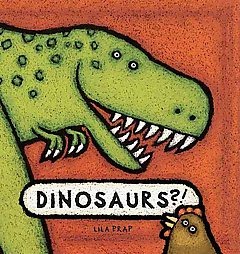
Dinosaurs have been done, and done, and done, but here's a new book you have to check out. DINOSAURS is narrated by a family of chickens. At the beginning of the book, Mama Hen finds a book behind the barn. The book claims that chickens, are descendants of dinosaurs. The chicken family sets out to find out whether or not this is actually true.

The format of this book is really clever. Each page, beginning with the title page, has a chick just coming out of the egg. The chick is asking a question, e.g. "What does the word DINOSAUR mean?" The next two-page spread answers that question. The answer is contained in the heading. Around the left hand side and bottom, the family of chickens continues to question and converse about the topic Mama her baby chicks ask lots of questions. Papa Rooster is blustery and unbelieving. The right hand border of each page gives more detailed information. There is a large dinosaur, done mostly in shades of brown, green, gold, and blue (with a little of what appears to be almost like splatter painting- really interesting art) in the middle of each spread. A paragraph on the bottom of the right hand page gives information about that dinosaur. And then there's that little chick coming out of the egg, asking the question that leads the reader onto the next page…The back endpages give an actual timeline of how chickens might have evolved from dinosaurs.

A really clever treatment of dinosaurs. Great for teaching kids about the question/answer process of research. Kids are going to love this one!

Wednesday, October 13, 2010

SEEDS OF CHANGE- JEN CULLERTON JOHNSON


"Those trees you are cutting down today were not planted by you but by those who came before. You must plant trees that will benefit the community to come, like a seedling with sun, good soil, and abundant rain, the roots of our future will bury themselves in the ground and a canopy of hope will reach the sky."

SEEDS OF CHANGE is the biography of Nobel Peace Prize winner Wangari Maathai. Maathai grew up in Kenya and attended college in the United States. When she returned to Kenya, Matthai was deeply saddened by the deforestation of her country. She started the Greenbelt Movement, a group which restored the Kenyan countryside by planting over thirty million trees. Matthai was a groundbreaker many times over-- when she was growing up, not many girls went to school, or continued on to college, or became university professors. At one point, she was even jailed by corrupt politicians more concerned about profits than reforestation. This is a well-told story with gorgeous, vibrant, richly illustrations (by artist Sonia Lynn Sadler) that beg to be closely examined.

I could use this book in a hundred ways. Our second graders are doing a science unit on trees and plants right now. Almost every day, a very serious seven-year-old reminds me that I should not cut down any trees because they give oxygen to the earth. I'll start by giving the book to them this morning. Our third graders are working on ecosystems and this book would be perfect for that unit. It's also a great biography. Or would be perfect in a unit on courage. Or change. Or the power of the individual. Or it might be fun to look for other books about Nobel Peace Prize winners and string them together. And then there are those illustrations, that just beg to be studied and imitated…

Tuesday, June 8, 2010

ROCKS! ROCKS! ROCKS! Nancy Elizabeth Wallace

If you work with young children, you probably know Nancy Elizabeth Wallace, the author of SHELLS! SHELLS! SHELLS! and FLY, MONARCH, FLY! In Wallace's newest book, ROCKS! ROCKS! ROCKS! Buddy Bear visits the Rock Ridge Nature Center. He and his mom hike the Blue Diamond Nature Trail, where Buddy learns some basic geology facts and concepts, e.g. the earth is a ball of rock, rock erodes over time and that there are more than one hundred kinds of rocks. They also meet a park ranger who teaches them how sedimentary, igneous, and metamorphic rock are made.

ROCKS! ROCKS! ROCKS! definitely rocks! The "facts wrapped in a story" format makes this fairly difficult topic easily accessible to young children. Diamond-shaped signs along the nature trail act as headings or subtitles and provide a great jumping off point for a discussion of how authors use different tools to support readers. Rectangular signs give kids with some fun facts to know and share. The illustrations are Wallace's trademark collage and include not only a variety of papers, but also some great photographs of rocks. Appendixes encourage young petrologists to start a rock collection, make rock magnets, write a rock joke, or build a cairn. Two other appendixes list rock places, e.g. Rocky Ford, Colorado, and rock sayings.

Visit Nancy Elizabeth Wallace's website here.

Tuesday, January 5, 2010

MY LITTLE POLAR BEAR- Claudia Rueda

Sunday morning. I'm on a post church, pick up a gift, run through of a local bookstore. I know exactly what I want and have no reason to go further than twenty feet inside of the store. Even so, the siren song of the children's book area calls to me, and I head to the back of the store, just for a minute.

I'm immediately drawn to the pale blue, sprinkled with white sparkles cover of MY LITTLE POLAR BEAR. I open it and know that I have found a new favorite. This book, a dialogue between a mama polar bear and her cub, works on a lot of different levels. First, it's a really sweet RUNAWAY BUNNY kind of story about the love between a mama and her child- it would be a terrific baby present. I'm guessing that could quickly become one of those bedtime ritual books that young children would ask for again and again. The illustrations, all done in shades of blues and grays and whites, are quiet and soothing.

This seemingly simple bedtime story, however, could be used in a whole different way. On each two page spread, the cub asks for reassurance as to whether it is really a polar bear. Rueda uses specific factual information, "Your feet are large and padded. You can walk on snow and melting ice, just like a polar bear. You smell seals from far away." I could see using MY LITTLE POLAR BEAR, then, as a model for research reports for primary grade students. Even kindergarteners with a few good facts could write a really nice little research report using MY LITTLE POLAR BEAR as a mentor text. I can't wait to try it.

A beary nice find, perfect for this time of year…

Saturday, December 12, 2009

The Wonders Inside the Human Body- Silver Dolphin Books

Publisher: Silver Dolphin Books
Copyright: 2009
Review copy provided by publisher

I'm dating myself, but when I was a little girl, one of the books I absolutely loved was the WORLD BOOK ENCYCLOPEDIA, and specifically the H volume of the WORLD BOOK. I loved H because H contained the Human Body. And the Human Body had all of these great color transparency diagrams. First, you saw the outside of the body. Carefully, carefully turn that page, and you saw the nerves and blood vessels. Turn again, and you were inside the body, looking at the organs. I spent hours poring over the pages in that book (and fighting with my sisters over who got to look at the H book, but that's a story for another day).

Recently I received a review copy of THE WONDERS INSIDE THE HUMAN BODY. As I read through it, I felt like I was carried back in time to my WORLD BOOK ENCYCLOPEDIA DAYS, except this book is way, way better than that. WONDERS INSIDE THE HUMAN BODY has over 90 pages of color transparencies, way, way, way cool photographs, sophisticated diagrams, and cut aways. The text in the book is minimal, instead, most of the information is contained in the extensively labeled photographs and diagrams. There are two page spreads on any number of aspects of the human body- different organs, systems, senses, etc.

This book would make a terrific Christmas present. It would be a terrific invitation for those "developing readers" in your life- they could pore over the images in this book for hours, and the need to know about those pictures would get them through the brief amount of text. It would be a great mentor text for a nonfiction unit- you could teach kids about simple and complex diagrams, cutaways, writing interesting captions. There is also a really interesting color coded table of contents.

A plethora of images and information sure to delight any reader…

Wednesday, November 25, 2009

THE BOOK AUNTIE: FOR THE HORSE LOVERS IN YOUR LIFE

Review copy provided by publisher

My niece and nephew have always known me as the book auntie. Since they were born, I've deluged them with books for every Christmas, holiday, and birthday. Yeah, I give the stuff on their lists- the purses and legos and video games, but I also make sure there is a book (or two or three or ten) under the Christmas tree. My books were never the first presents Gregory or Megan opened or played with, but they always got used and loved eventually. And the books they usually lasted a whole lot longer than the other stuff I bought! Over the next few weeks, I'm going to feature a few books that would be perfect book auntie presents.

HORSES: ACTION FILES (Silver Dolphin Books) is a book for the horse lovers in your life. The book is not really just a book, it's actually a collection of all things horse. Opening the cool 3D cover (which makes me a little nauseous, but I think it's a function of old age!), the reader finds a 24 page fact file with sections on the anatomy of a horse, horse types, horse care, and fun and games with horses. There are lots of great photos and drawings, diagrams, fascinating facts, and suggestions for further research and activities. The publisher has a website that covers not only horses, but lots of other great nonfiction topics as well. There are suggestions for other books (fiction and nonfiction) and also movies. I can definitely see myself using this book in a classroom nonfiction study- it's well written, has interesting information, and it has lots of text features that kids need to know and be able to use.

I would have bought HORSES based on the fact file alone. This book contains lots of other goodies though, and I would be remiss if I didn't mention them. There are sixty horse stickers, scattered on pages throughout the book. There are 18 info cards, each showing a different breed of horse (kind of like baseball trading cards) and a special envelope to keep them in. There is a horse mask kids can assemble. There is a giant foldout poster. And there is a fiction selection, not quite novel length, but longer than a picture book.

More good news. If you know kids who love sharks, or Egypt, or gladiators, those are other topics currently available in this series. I'm hoping there will be lots more eventually.

My niece and nephew are 19 and 21. HORSES probably won't work for either of them, but it's definitely going under someone's tree…

Wednesday, November 18, 2009

KEEP ON: THE STORY OF MATTHEW HENSON, CO-DISCOVERER OF THE NORTH POLE- DEBORAH HOPKINSON

Deborah Hopkinson (SWEET CLARA AND THE FREEDOM QUILT, SKY BOYS) is one of my favorite picture book authors. Hopkinson knows how to take a story from history and tell it in a way that makes it interesting and accessible to kids. Her latest book, MATTHEW HENSON: CO-DISCOVERER OF THE NORTH POLE is certainly no exception.

Matthew Henson was born about the time the Civil War ended. As a young African American boy, he had big hopes for seeing the world, but not much hope of fulfilling them. Orphaned at 13, Henson somehow managed to convince the captain of a sailing ship to hire him as a cabin boy. The captain took fondly to young Matt and schooled him in the ways of the high seas. Five years later, the Captain died, and Matthew Henson ended up back on land, working in a store. That's where he met Admiral Peary.

Admiral Peary is a man many of us know as the discoverer of the North Pole. But did you know that he was actually not alone when he made this discovery? Peary was accompanied by none other than Matthew Henson. In fact, Henson was actually the one who bonded with the Inuit people, trained the sled dogs, and stood next to Peary at the Pole (after surviving a fall into the icy water a few days earlier). Amazingly, after they returned from their expedition, Henson worked as a parking lot attendant because that is the only job he could get.

I loved everything about this book- Hopkinson's powerful storytelling, Henson's journal entries, the end pages that include author's note and timeline, and Stephen Alcorn's oh so beautiful illustrations, done in hues of blues, and oranges, and golds. I will be using KEEP ON as the center of an African American history unit in January. Matthew Henson has a lot to teach my kids about dreams, and tenacity, and perserverance, and dignity. Some pretty important life lessons, I think!
**********
P.S. In case you are wondering why I have not been blogging--Ten days ago, my computer had an unfortunate accident (laptop bag meets parking lot, parking lot 1, laptop 0) and I have been without internet at home since then.